SoundWright · Narrative Audio Studio
Edit intent,
not waveforms.
The production engine for spoken audio — script to master, and master back to script. One engine. Two doors. Every revision surgical.
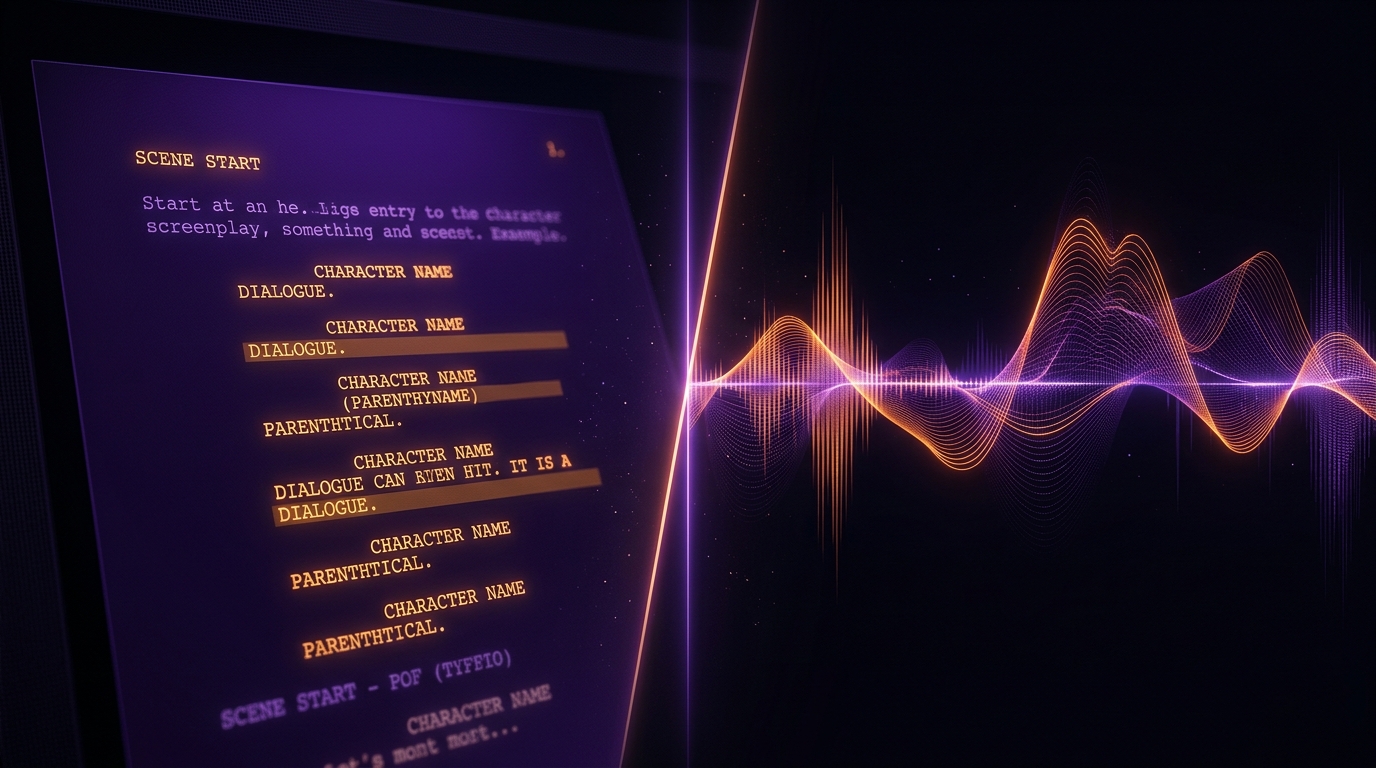
One engine, two doors
Script to master. Master back to script.
Both doors land in the exact same session format. Revisions are surgically isolated: fixing one line re-renders exactly one stem while untouched audio remains byte-identical.
"I wrote it"
Fountain screenplay or manuscript chapter in → auto-cast from voice-similarity shortlists → full-cast multi-character performance in minutes → auto-ducked stems, loudness mastered to spec.
- Native Fountain parsing with 8-directive performance DSL
- Dual-embedding voice casting (sound and speaker identity)
- Auto-ducked music beds, room-tone injection
- LUFS compliance target verification
- What costs $275–$5,000 and weeks to schedule — for dollars, repeatable on every rewrite
"I recorded it"
Finished audio in → 7-stage decompile (source separation, sound classification, transcription, speaker diarization) → editable, text-addressed session → delete flubs as text, retake single lines, re-master.
- 7-stage decompilation pipeline — no competitor has this
- Edit flubs as text, not waveforms
- Retake single lines without re-recording
- Works on interviews, lectures, podcasts, voice memos
Production architecture
Not a voice generator. A production studio.
SoundWright is the orchestrator — it manages stems, identity, revision, and mastering across any voice provider.
Stem-native substrate
Stems are the persistent foundation, not an afterthought export. Projects appreciate in quality as underlying TTS models improve.
Provider-agnostic routing
Any registered provider or our own house voices — assigned per track. Acts as a COGS dial. When voices get better, your existing catalog gets better here.
8-directive performance DSL
Author performance semantics directly in the script: @overlap, @silence, @bed, @duck, @xfade, @track, @take, @group.
Surgical revision
A fixed line re-renders one stem. Everything untouched stays byte-identical. Music ducks under voice automatically. Loudness is a target the system hits, not a skill the customer learns.
Provenance & AI disclosure
Records model, seed, and cache hash per stem. Every render issues a receipt recording what was produced and how.
Dual-embedding voice casting
Cross-provider voice search using sound and speaker embeddings. "Find voices like this" — across every registered provider simultaneously.
Competitive position
Every competitor sells the first ten minutes. Nobody sells the rest.
4.4 million active podcasts.
Four hours of waveform surgery for every published hour.
Transcript editors solved one tenth of the answer. SoundWright is the other nine tenths.